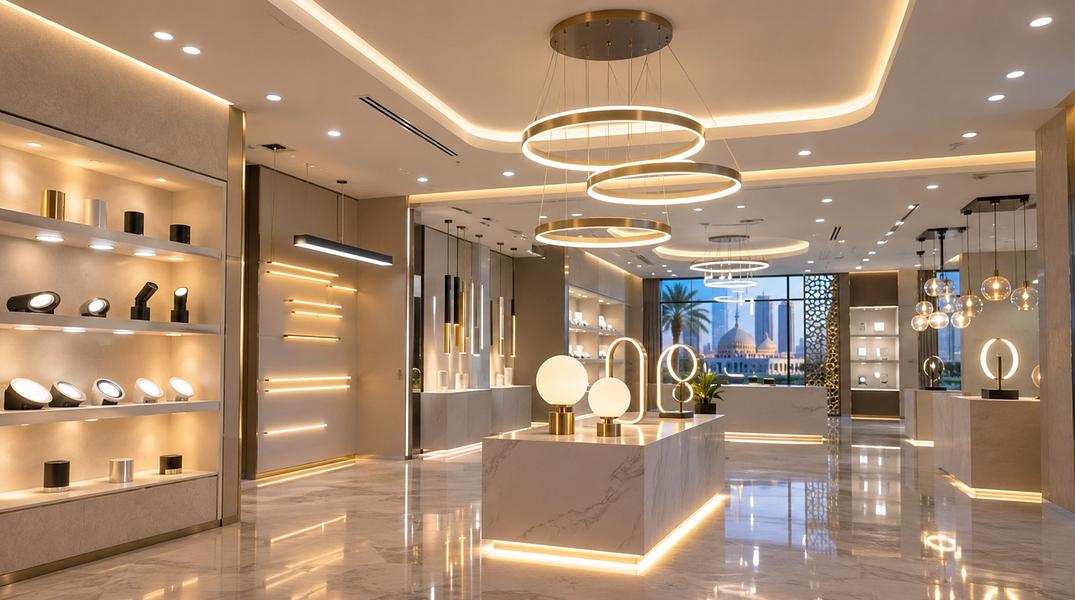
Lighting shops in Abu Dhabi and Sharjah sell everything from cheap LED bulbs to architectural fittings for villas and showrooms. The boxes are full of numbers, and two lights that look the same in the shop can look very different on your ceiling. This guide explains the numbers that matter and what to check before you buy for a home, shop or office.
Lumens, not watts
With LED, watts tell you how much electricity a light uses, not how bright it is. Brightness is measured in lumens (lm). As a rough guide, an LED bulb of about 800 lumens replaces an old 60 W bulb. Compare lumens per watt as well: the higher it is, the less electricity you pay for the same light.
Warm, neutral or cool white?
Colour temperature is shown in kelvin (K):
- 2700K to 3000K (warm white): yellowish and relaxing. Good for bedrooms, living rooms and majlis areas.
- 4000K (neutral white): clear without being harsh. Good for kitchens, offices and shops.
- 5000K to 6500K (cool white or daylight): bluish and very bright. Used in warehouses, workshops, car parks and some showrooms.
Pick one colour temperature per room. Mixing warm and cool fittings in the same space looks uneven.
CRI: how true colours look
The colour rendering index (CRI or Ra) shows how naturally a light shows colours, on a scale up to 100. CRI 80 is fine for most rooms. For clothing shops, salons, furniture showrooms and kitchens, look for CRI 90 or more, so colours look the same under your lights as they do outside.
IP ratings for bathrooms and outdoors
The IP rating shows protection against dust and water. Bathrooms need at least IP44 near the shower, and outdoor lights on villa walls, gardens and balconies should be IP65 or higher to cope with sand, dust and the occasional rain. A light without an IP rating is for dry indoor use only.
Heat is what kills LED lights in the UAE
LEDs last a long time, but the driver, the small electronic part that powers them, does not like heat. Fittings inside false ceilings, on sun-facing walls or in hot warehouses fail much sooner if they are poorly made. Choose fittings with a solid metal heat sink, ask for the driver brand and warranty, and avoid closing recessed downlights inside insulation.
Before you buy
- Dimming: only dimmable LEDs work on a dimmer, and the dimmer must be compatible. Ask before you buy.
- Beam angle: narrow beams (around 24 to 36 degrees) are for highlighting shelves or artwork; wide beams (60 degrees and more) light a whole room.
- Warranty: good fittings usually come with two years or more. Keep the invoice.
- Buy spares from the same batch: the shade of white can vary between batches, so buy a few extra for later replacements.
- Trade buyers: for a fit-out, ask the supplier for data sheets with lumens, CRI, IP rating and lifetime before you order in bulk.
Find lighting on TradoO
- Lighting fixtures in Abu Dhabi
- Lighting fixtures in Sharjah
- LED bulbs and fixtures in Abu Dhabi
- LED bulbs and fixtures in Sharjah
- Decorative lighting in Abu Dhabi
Frequently asked questions
What colour temperature is best for a home in the UAE?
Most people choose warm white (2700K to 3000K) for bedrooms and living areas and neutral white (4000K) for kitchens and study rooms.
Why do my LED downlights keep failing?
Usually heat or a poor driver. Cheap fittings in hot false ceilings fail early. Replace them with fittings that have a metal heat sink and a branded driver, and check the wiring and voltage with an electrician.
Are LED strip lights good for false ceilings?
Yes, for indirect light in cove ceilings. Use an aluminium profile to carry heat away, and a driver sized above the total wattage of the strip.