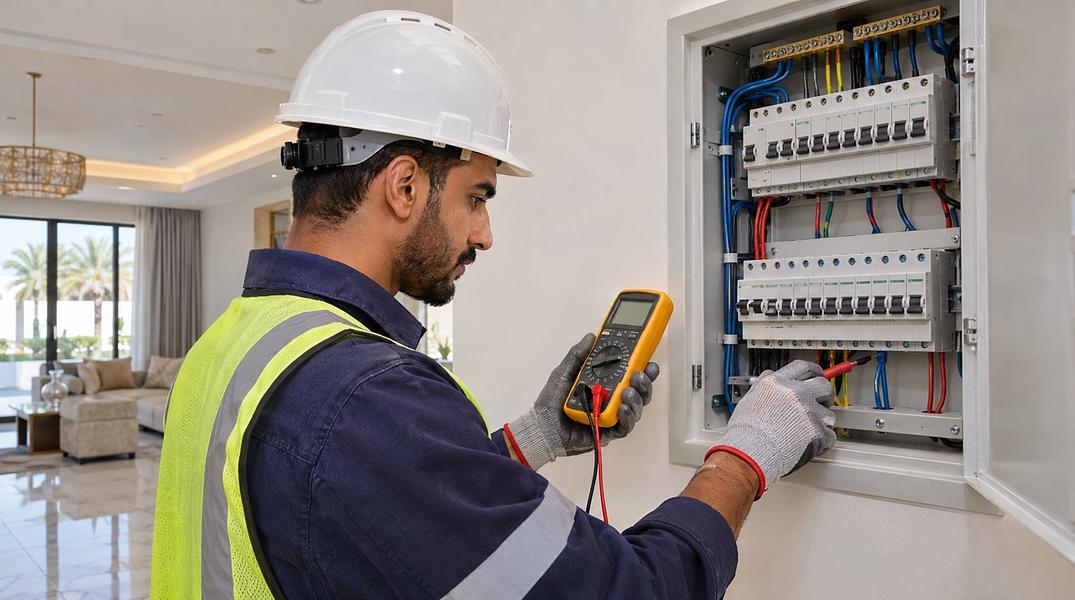
Homes and shops in the UAE run heavy electrical loads: several ACs, water heaters, kitchen appliances and, in shops, lighting and display fridges for long hours. Most problems start small, with a breaker that trips or a socket that gets warm, and are cheap to fix early. This guide explains the warning signs, which jobs need a licensed company and what to ask before an electrician starts work.
Warning signs you should not ignore
- A breaker or the earth leakage switch (RCD/ELCB) that keeps tripping.
- Sockets or switches that feel warm, are discoloured or crackle.
- A burning or plastic smell near the distribution board or a socket.
- Lights that flicker or dim when the AC or water heater switches on.
- Small shocks when touching an appliance or a tap.
If you smell burning or see smoke, switch off the main breaker if it is safe to do so and call an electrician immediately. Do not keep resetting a breaker that trips again and again: it is protecting you from a fault.
Small jobs and bigger jobs
A handyman or maintenance company can usually handle small jobs such as replacing a socket, a switch, a light fitting or a ceiling fan. Bigger jobs, such as rewiring, adding circuits, upgrading the distribution board, a new connection or increasing the load for a shop, should be done by a licensed electrical contractor. Work that changes the connection or the load usually needs approval from the local utility: DEWA in Dubai, SEWA in Sharjah, and the electricity distribution company in Abu Dhabi. A licensed contractor knows the process.
What to ask before work starts
- Is the company licensed for electrical work, and can they share the trade licence?
- Is the quote fixed, and does it include materials, or are parts charged separately?
- What brand of cables, breakers and sockets will they use?
- Is there a warranty on the work?
- For tower flats and shops, do they need a work permit from the building management?
Buying electrical materials yourself
If you buy sockets, switches, cables or lights yourself, buy from established suppliers and check the rating on the product. The UAE uses 230 volts and three-pin British-style sockets (type G). Cheap unbranded cables and extension boards are a common cause of overheating, so choose known brands and the correct cable size for the load.
Find electrical services on TradoO
- Electrical services in Sharjah
- Electrical services in Dubai
- Electrical services in Abu Dhabi
- Electrical fittings and cables in Abu Dhabi
- Electrical fittings and cables in Sharjah
- How to choose LED lighting
Frequently asked questions
Why does my breaker trip when the AC starts?
Common causes are an overloaded circuit, a weak or faulty breaker, a fault in the AC compressor or wiring, or moisture. An electrician can test the circuit and the AC to find which one it is.
Can I change a socket myself?
Only if you are competent and switch off the circuit at the board first. For anything beyond a like-for-like replacement, call an electrician.
What is the difference between a breaker and an RCD?
A breaker protects the wiring from overload and short circuits. An RCD (earth leakage switch) protects people by cutting the power when current leaks to earth, for example through a damaged appliance.