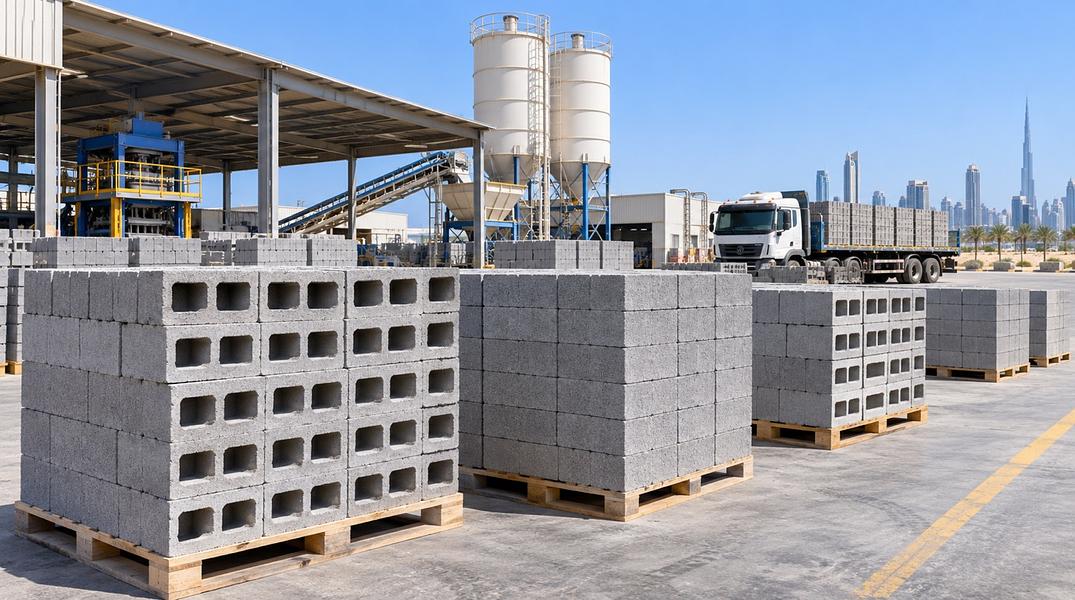
Concrete blocks are used in almost every building project in the UAE, from boundary walls and villa extensions to warehouses and labour camps. Block factories in Abu Dhabi, Mussafah, ICAD, Dubai and Sharjah produce several types and sizes, usually sold by the piece and delivered by truck. Choosing the right block and ordering the right quantity saves money and delays on site.
What types of cement blocks are there?
- Solid blocks: heavy and strong, used for load-bearing walls, foundations and boundary walls.
- Hollow blocks: lighter, with cavities that reduce weight and cost; common for partition and external walls in framed buildings.
- Thermal (insulated) blocks: blocks with insulation inside, used to reduce heat gain and meet green building rules for many new buildings.
- Lightweight blocks: such as AAC blocks, easy to cut and quick to lay, with good insulation.
- Interlock pavers and kerbstones: often made by the same factories for driveways, yards and roads.
Which block sizes are common?
Blocks are usually named by their thickness, such as 4 inch, 6 inch and 8 inch (about 100, 150 and 200 mm), with a standard face of about 400 x 200 mm. Thicker blocks are used for external and load-bearing walls, and thinner ones for internal partitions. Always follow the sizes and strength on your structural drawings or the consultant's specification.
How many blocks do you need?
With a face of 400 x 200 mm, you need about 12.5 blocks for each square metre of wall. Work out the wall area, subtract doors and windows, multiply by 12.5, then add a margin of around 5 percent for cutting and breakage. A contractor or the factory can help check the quantity for larger jobs.
What should you ask the factory?
- Strength and test certificates: the compressive strength and whether the blocks meet the authority or consultant requirements.
- Curing: blocks need time to cure; ask how long they have been stored before delivery.
- Price per block and delivery: whether transport, unloading and the pallets are included.
- Minimum order: and the delivery time to your site.
- Thermal blocks: the insulation type and any approval needed for your project.
Tips on site
- Check blocks on arrival for cracks, broken corners and uneven sizes.
- Store them on a flat, dry area and keep pallets wrapped until use.
- Order mortar, steel and lintels at the same time to avoid waiting.
- Keep the delivery notes and invoices for the project records.
Find cement blocks on TradoO
- Cement blocks in Abu Dhabi
- Cement blocks in Dubai
- Cement blocks in Sharjah
- Doors, windows and frames in Abu Dhabi
Frequently asked questions
What is the difference between solid and hollow blocks?
Solid blocks are heavier and stronger and are used for load-bearing and boundary walls. Hollow blocks have cavities that make them lighter and cheaper, and are common for walls in framed buildings.
How many blocks are in one square metre of wall?
For standard 400 x 200 mm blocks, about 12.5 per square metre. Add around 5 percent for cutting and breakage.
Do block factories deliver to site?
Most do, by truck, often with a minimum order. Ask whether unloading and pallets are included in the price.